

The goodnight robot
A sleepy robot character who says goodnight to everything in the bedroom, one line per thing.
How-to isn't up yet.
In this sample, a toy elephant becomes a picture-book character in yellow rain boots, a one-page story you read out loud, and a coloring page. Use your kid's actual toy.
The prompts below are samples for this project, not prompts from a session that already happened. Change the details to fit your kid's toy.
Ask her to bring the toy she loves most right now. This sample uses a floppy gray elephant. Any toy, stuffed animal, or even a favorite truck works.
3-year-old: chooses it and brings it over.
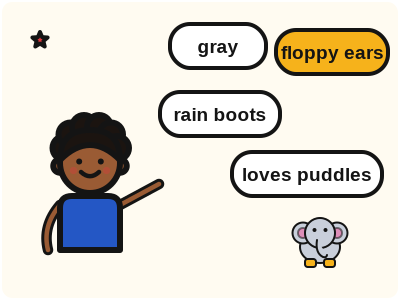
Before anybody touches a computer, the 6-year-old and I hold the toy and list words about it. What color? What does it feel like? What would it love to do? Write the words on paper. In this sample the fun detail is yellow rain boots, because this elephant loves puddles.
6-year-old: picks the describing words and the one fun detail. 3-year-old: points at ears, nose, feet when we ask "where's the...?"
I type into an image-making AI on my own account. He reads along (with help) and says what to change. I make a few versions and let her pick the winner by pointing or saying which one.
Sample prompt
Draw a cute picture-book character: a small, soft, gray toy elephant with big floppy ears and pink inside the ears, wearing bright yellow rain boots. It is about to jump into a puddle. Simple shapes, thick outlines, warm colors, plain cream background, friendly and happy. No text in the picture.
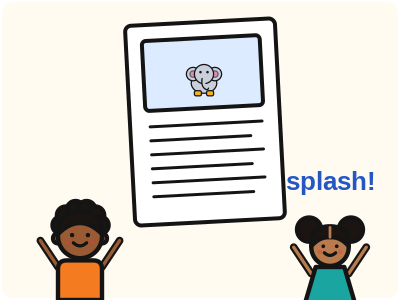
He tells me what happens. I type his idea into a writing AI and ask for something short enough to read in a minute. Then we read it out loud and change anything that doesn't sound like us. If a line doesn't fit the character, he can cut it.
Sample prompt
Help a 6-year-old boy and his dad write a one-page story, about 8 short sentences, for reading out loud to his 3-year-old sister. The hero is a small gray toy elephant in yellow rain boots who is looking for the biggest puddle. Use simple words and a sound to repeat (like "splish, splash") so his little sister can join in. Gentle ending at bedtime. Here is what the 6-year-old wants to happen: [his idea, in his words].
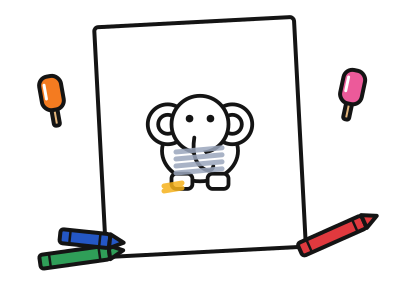
Ask for an outline version of the picture to use as a coloring page, print the story with the picture on top, and read it together. A repeating sound like splash gives the 3-year-old something to join in on. Then crayons.
Sample prompt
Make a black-and-white coloring page of the same elephant character in rain boots next to a puddle. Thick clean outlines, big simple areas to color, no shading, white background, no text.
The 3-year-old never types into anything. Her part is choosing, watching, and playing with what comes out.
Remix 1: a different adventure
Same character, new adventure: [toy] goes to the grocery store and helps find the bananas. Eight short sentences, one repeating sound, gentle ending.
Remix 2: a whole cast
Draw [toy 1] and [toy 2] as best friends in the same picture-book style: thick outlines, warm colors, plain background, no text.
Remix 3: a lift-the-flap page
Give me a simple "where is [toy]?" story with four hiding spots around a house, so we can make paper flaps to lift for each one.
A sleepy robot character who says goodnight to everything in the bedroom, one line per thing.
How-to isn't up yet.
A silly four-line bath song set to a tune you already know.
How-to isn't up yet.
6-year-old: saying what he actually means, noticing when the picture isn't what he pictured, and telling it what to change.
3-year-old: choosing, naming parts (ears, feet, nose), joining in on a repeating sound, and holding the real toy next to the picture.